
Role
Lead Product Designer
Team
Product Manager
AI Engineers
Front-end Engineers
@2026
What is Highspot?
Highspot is an AI-powered platform that helps sales teams work smarter by bringing content, training, coaching, and buyer engagement into one place—so teams can learn faster, find the right materials, practice conversations, and close more deals.
Impact
+15%
Pipeline
created
+14%
Average deal size
+16%
Win
rate
+20%
Reps attaining quota
+20%
Content
ROI
What is AI Role Play?
AI Role Play is a training tool that lets sales teams create and practice realistic sales conversations with AI personas, helping reps build skills, and product pitching in a safe environment before talking to real customers.
My Role
Own AI Role Play feature from concept to launch and updates.
Designed end-to-end flows for enablement and reps.
Added features like screen sharing and multi-persona scenario.
Worked closely with PM and engineering to ship iteratively.
Built prototypes to test and communicate ideas.
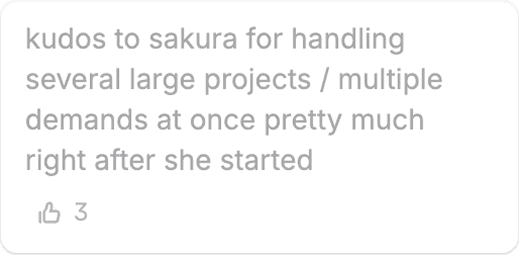
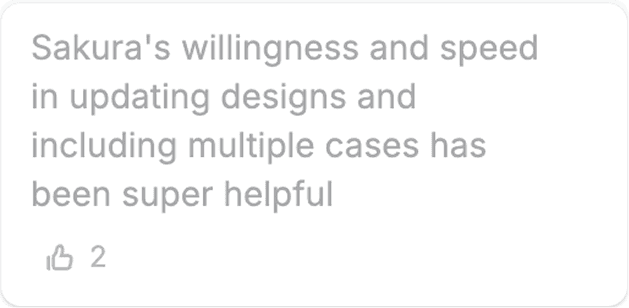
What my teammates say about me.
My Impact
Delivered AI Role Play from concept to all GA in 3 months.
Enabled 50,000+ enterprise training use cases in 3 months of launching and still counting, with more than 60% completion rate.
Contribute to 10% of Highspot profit after launching 2 months.
Contributed to Highspot’s Gartner Magic Quadrant Leader positioning by launching the AI Role Play capability
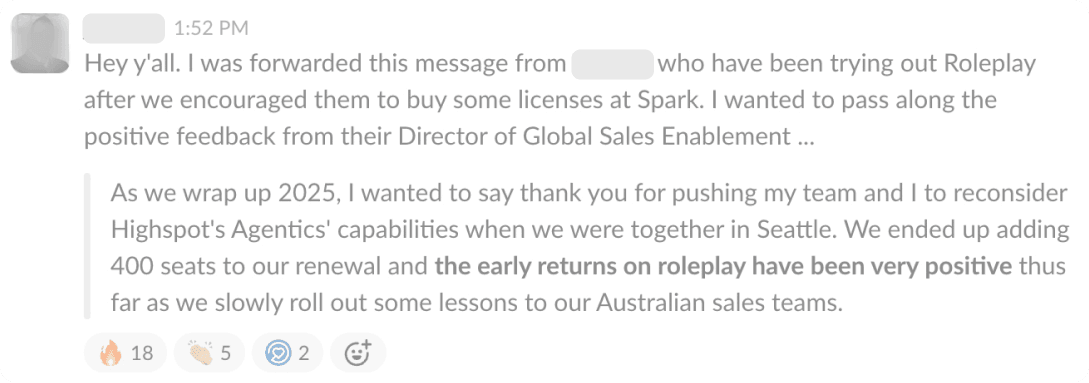
What our customers say about the product.
Who am I designing for?
Role 1

Rachel Kim
Sales Enablement Manager
"I want to build trainings to help team sell more effectively, with measurable impact."
Role 2

Alissa Hilton
Sales Rep
"I want to improve my relevant skills and readiness, so I can close more deals."
What did I do?
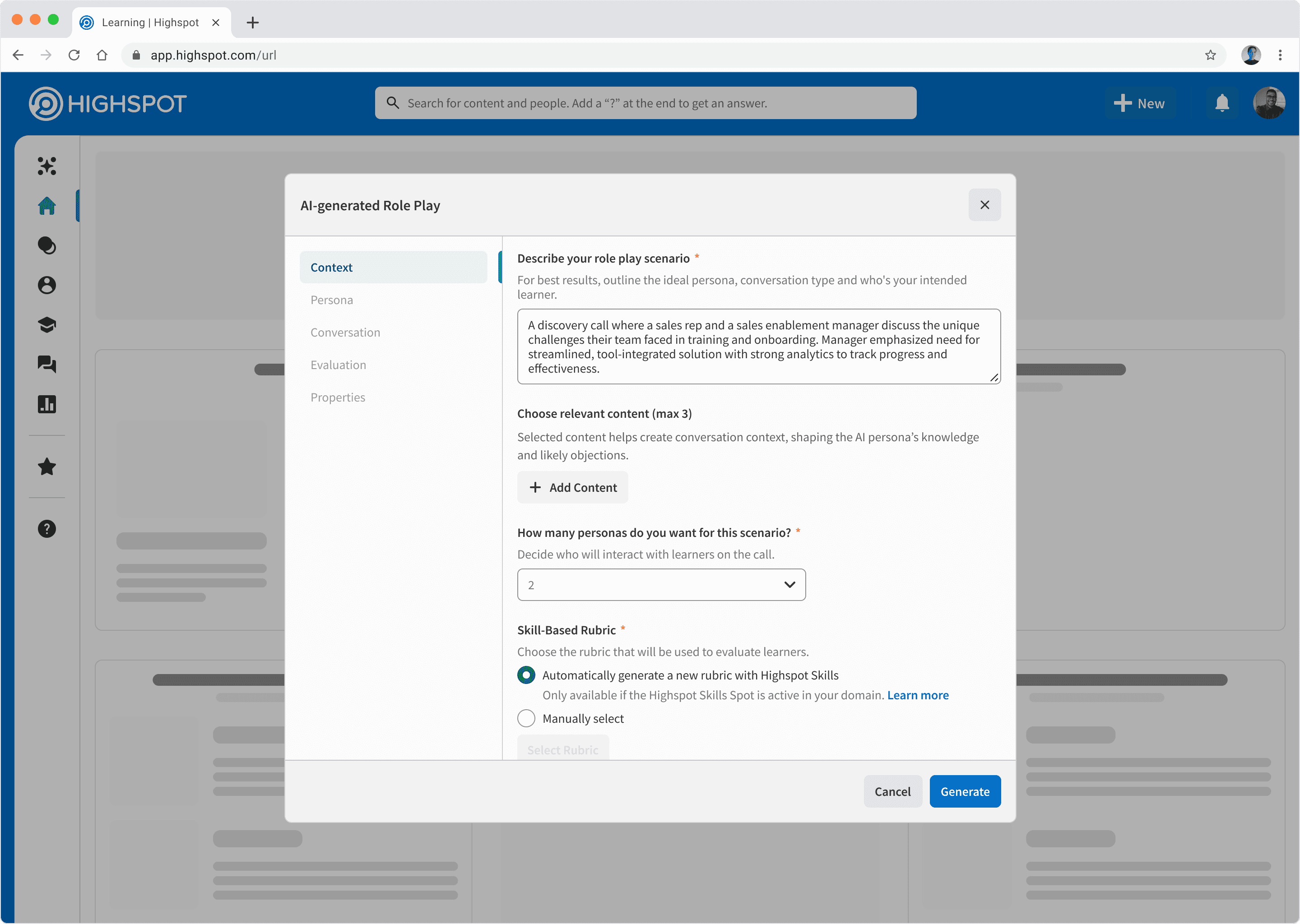
Manager Flow
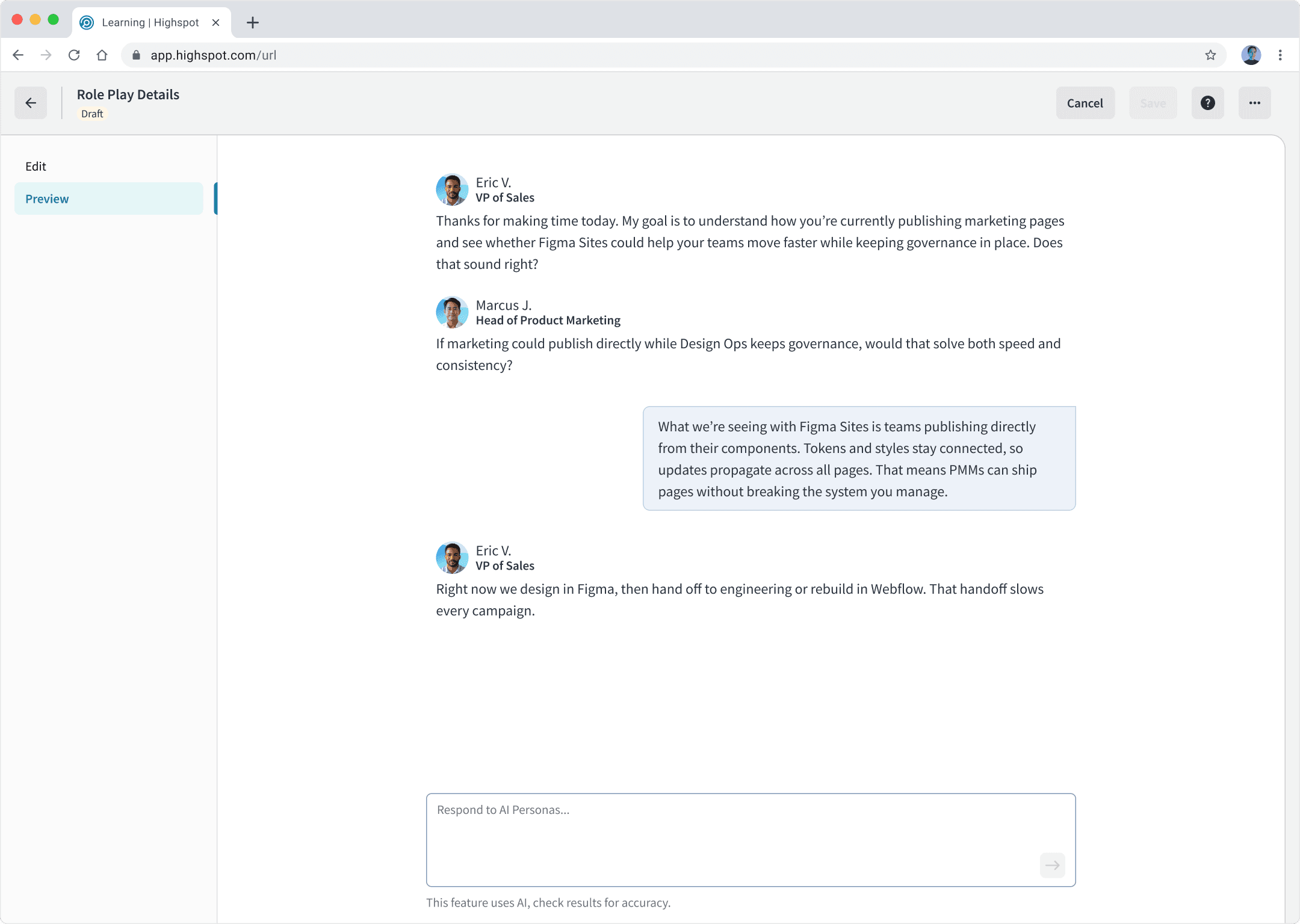
Rep Flow
Designed a low-friction, one-click entry to start role play with the right context.
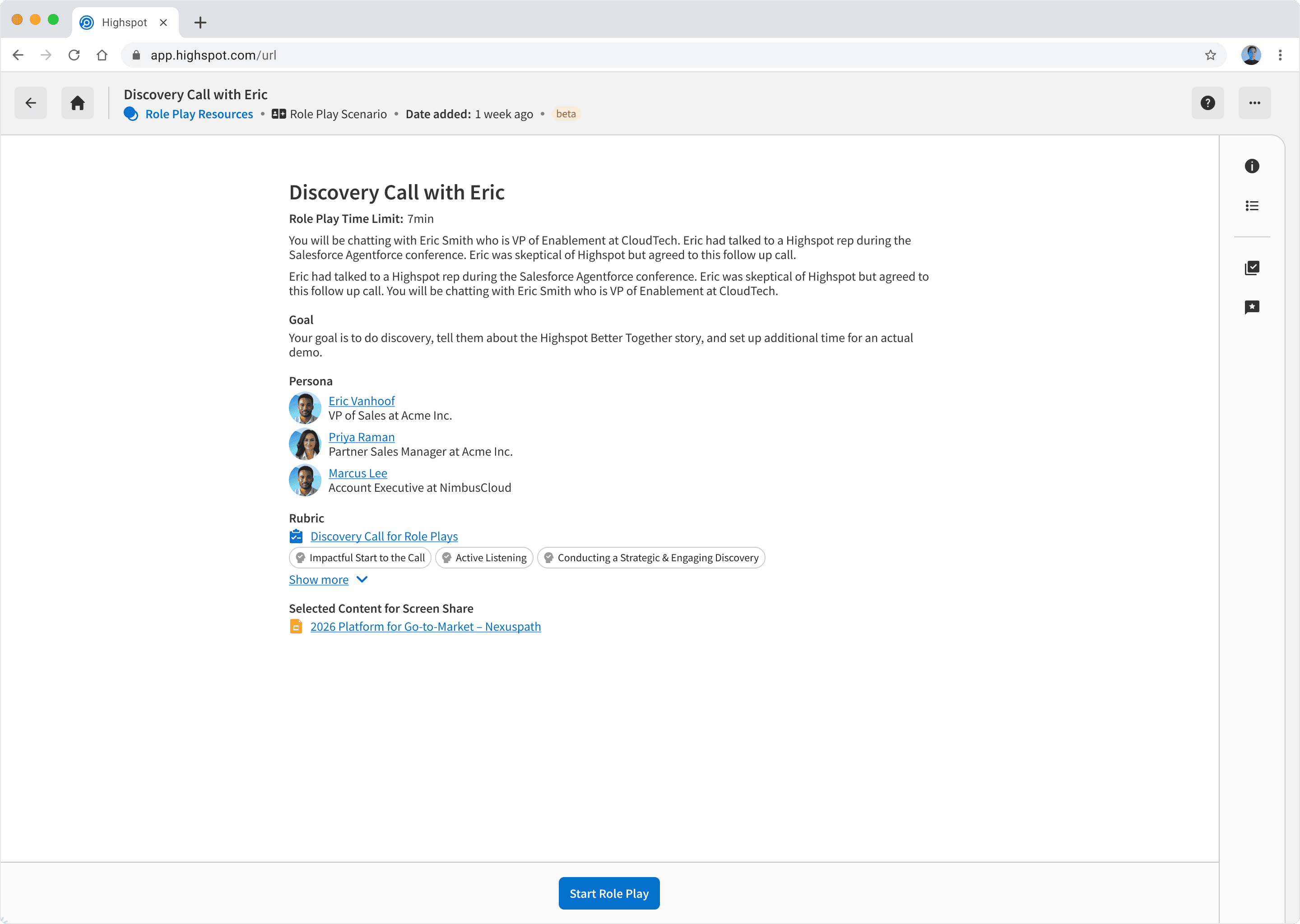
Take me there
Created a realistic, immersive call experience that simulates real customer conversations.
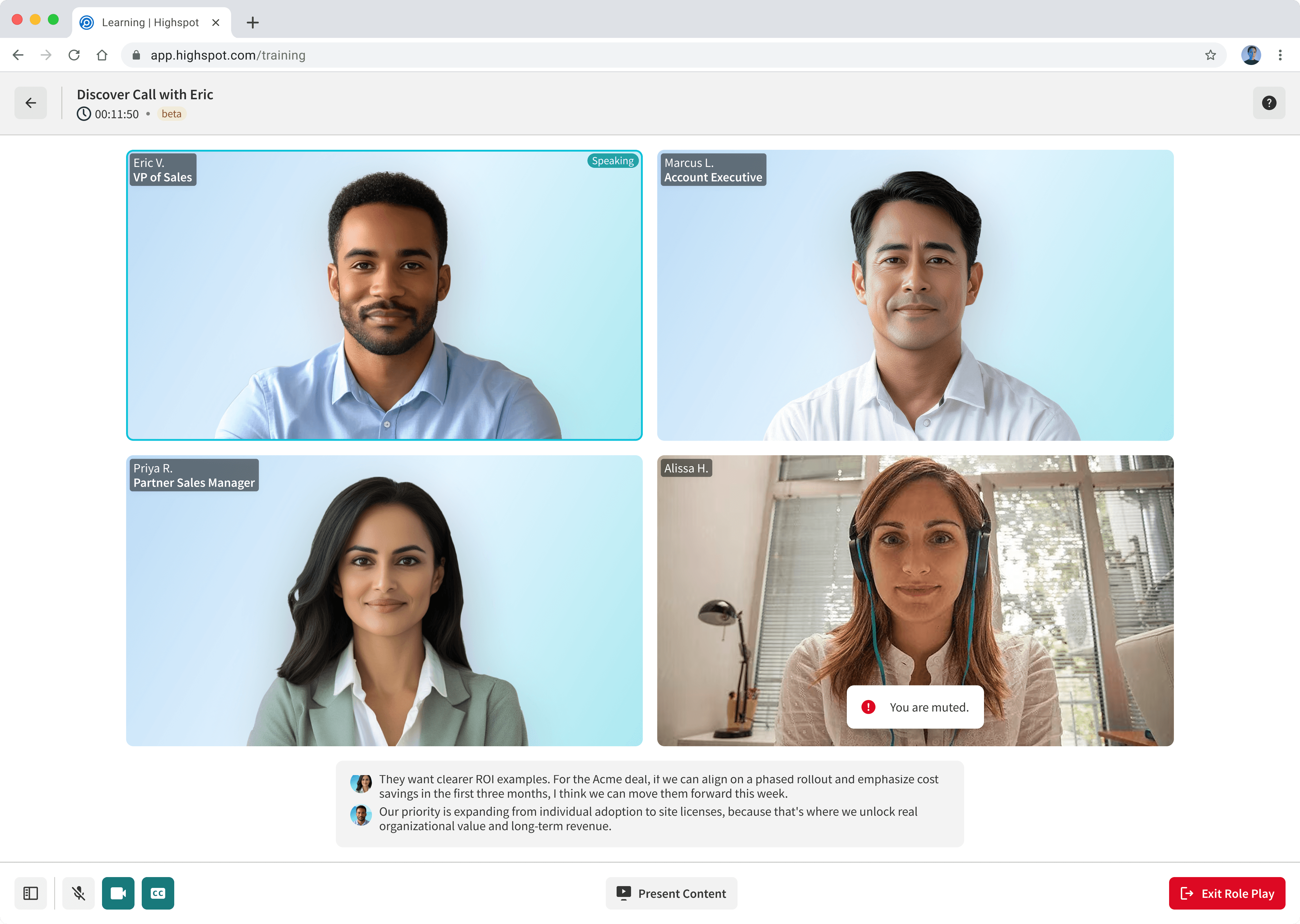
Take me there
Designed a feedback page with clear next steps for reps to improve future conversations.
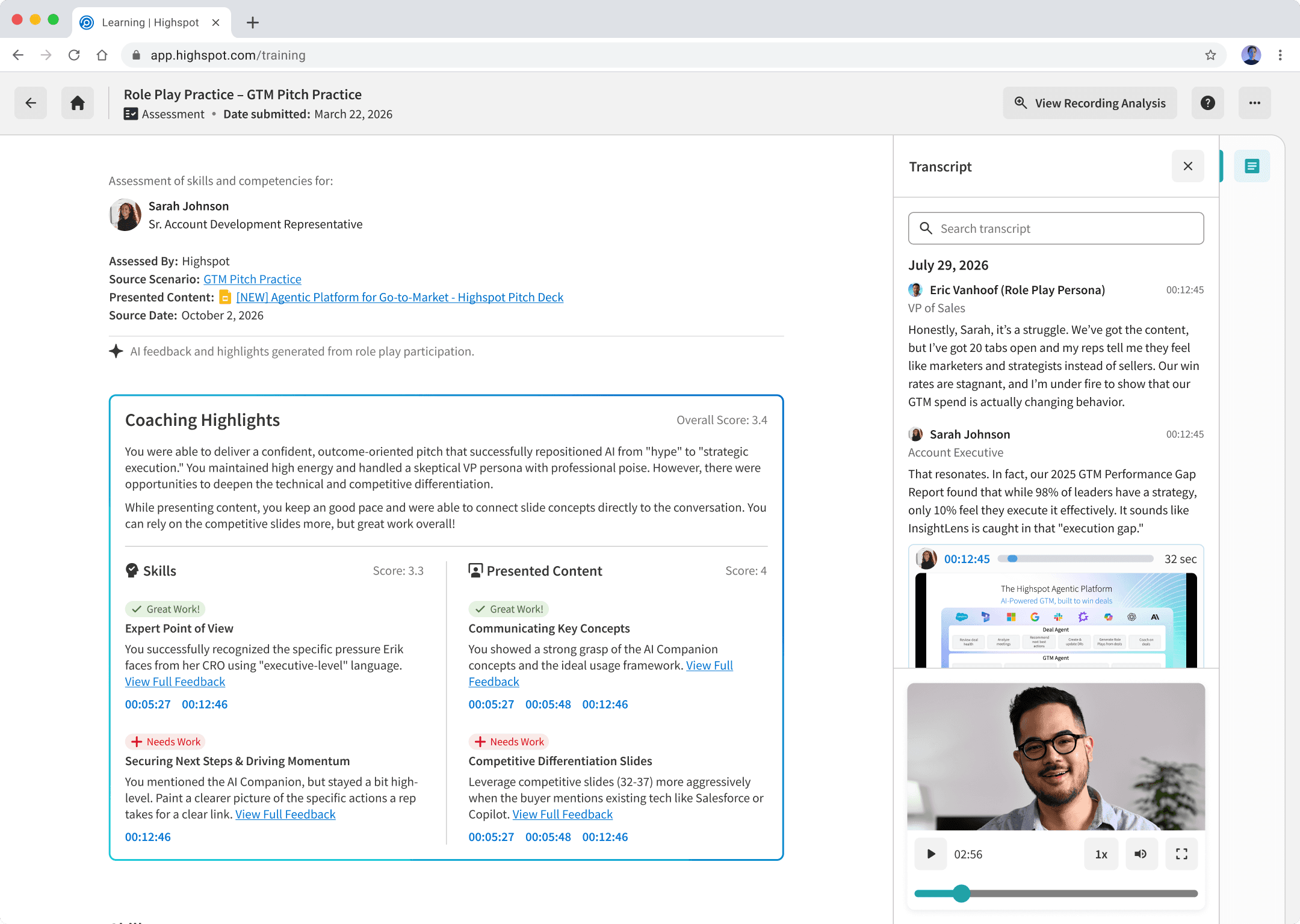
Take me there
How do I know my decisions are successful?
Why is AI role play needed?
I started by understanding users’ current workflows, identifying gaps in training and performance validation, and exploring how solving those gaps could drive business impact.
Rachel Kim
Sales Enablement Manager
Company:
B2B SaaS Company (1500 - 2000 Sales reps)
Team:
Data Cloud Service
Responsibility:
Build onboarding programs for new reps
Launch training for new product releases
Coach managers to coach effectively
Track rep progresses and skill gaps
Prove training impact to leadership
Goals:
Faster ramp for new hires
Higher training completion
Consistent manager coaching
More deals won by reps
Programs scaling without more headcount
Alissa Hilton
Sales Rep
Company:
B2B SaaS Company (1500 - 2000 Sales reps)
Team:
Data Cloud Service
Responsibility:
Run discovery calls
2. Complete training assigned by manager
3. Close net-new and expansion deals
4. Maintain accurate deal data in CRM
Goals:
Improved call quality (discovery, objection handling)
Apply training in real conversations
Higher quota attainment
Win rate for net-new and expansion deals
What Rachel Needs:
A scalable way to verify that reps can apply training in real conversations before customer calls.
What Alissa Needs:
To improve real-world readiness to adapt when conversations go off-script.
Business Goal - Enablement Loop

How to create a Role Play?
Creating a role play requires a lot of information, so the design challenge was making the process feel simple and manageable. I started by identifying what information was needed and why.
1
Background - what information does admin need to provide?
a
Persona
AI buyer the rep will interact with
b
Conversation Background
AI buyer the rep will interact with
c
Objection or Concern
Key concerns or challenges to simulate
d
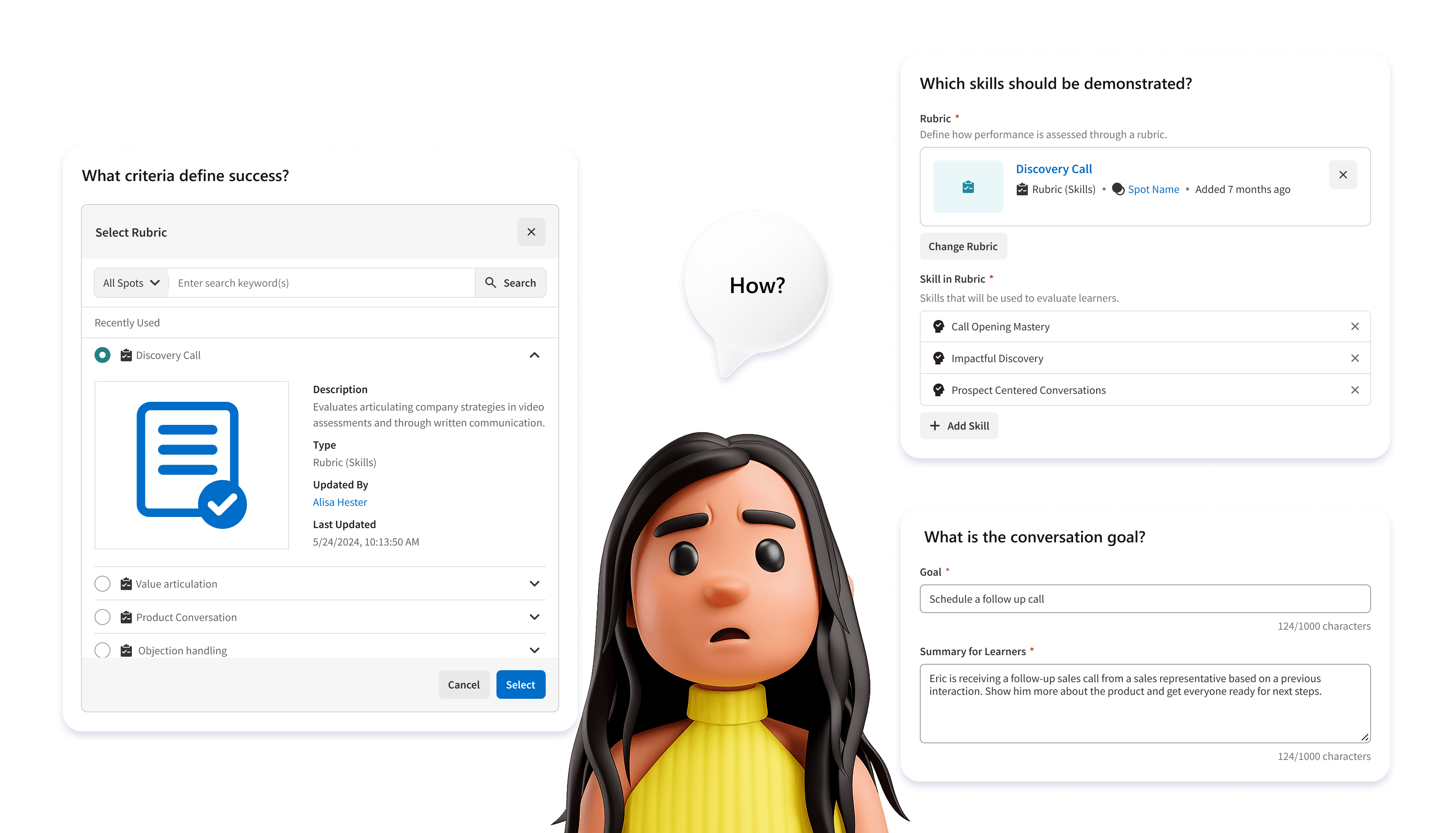
Rubric
How the performance will be assessed
e
Selected Content for Presentation
Materials the rep should use


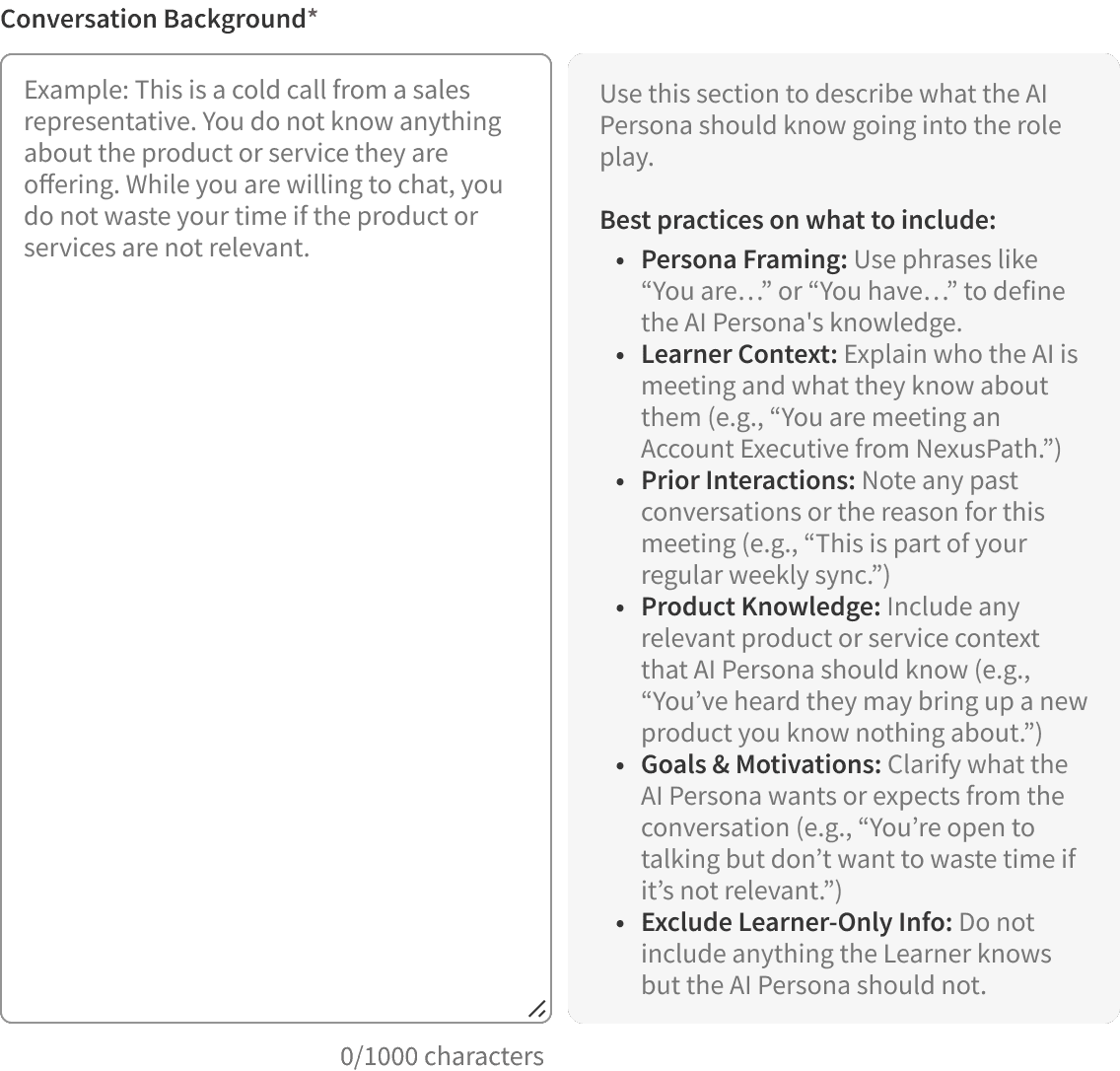


It doesn't look that intimidating until we are in Rachel's shoes:
What Rachel knows

What Rachel needs
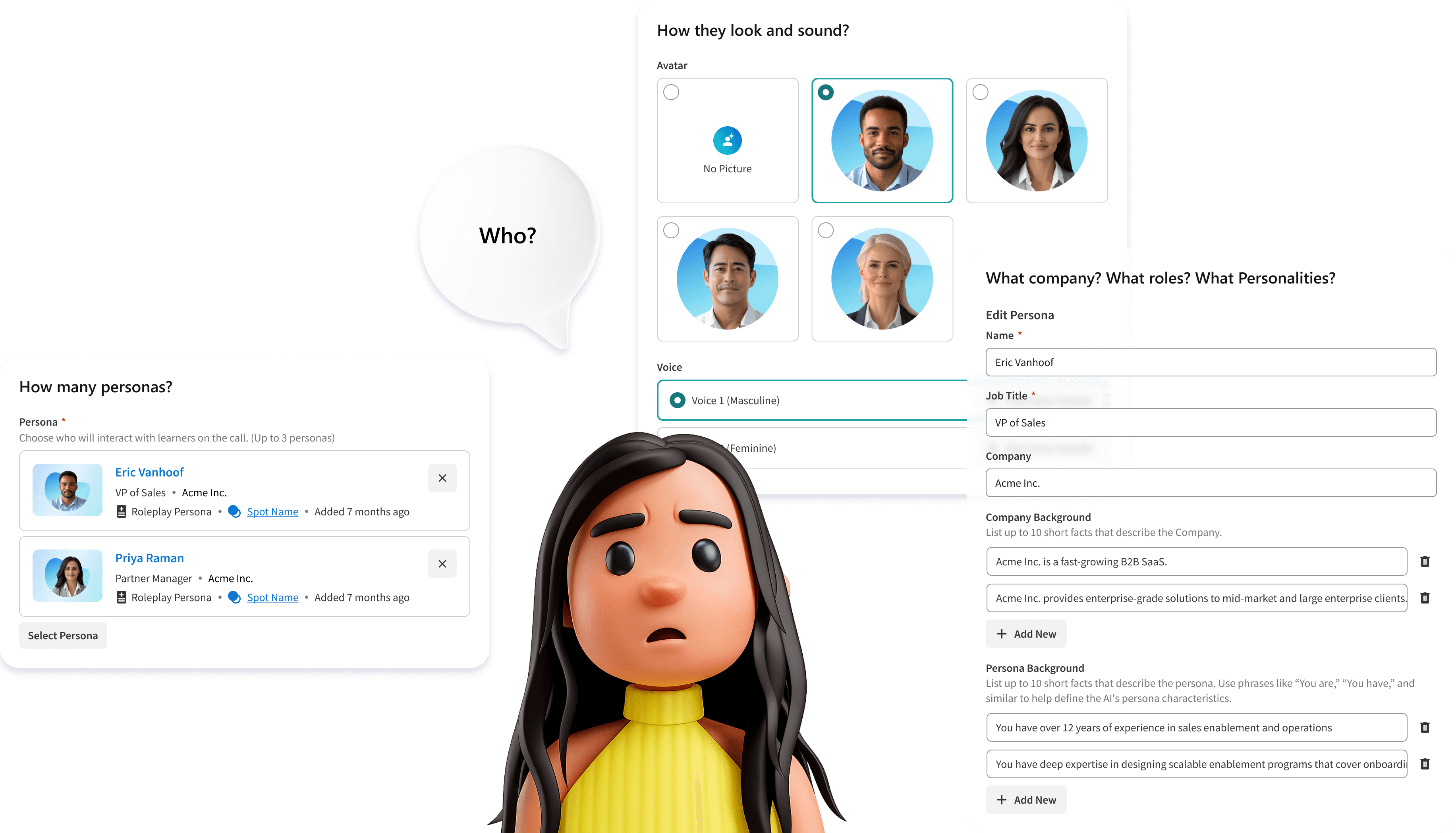
What Rachel needs

What Rachel knows
After all, Rachel feels:
High Cognitive Load
C1
“I kept scroll up to reference information I input earlier..”
C3
“Too many text inputs..I need to reference messaging, MEDDICC, and objections all at once.”
Time Consuming
C2
“Creating a role play feels like building it from scratch every time.”
C4
“By the time I finish creating one scenario, I could’ve coached 3 reps live.”
Difficult to Scale and Reuse
C3
“Every new training initiative feels like starting from zero.”
C2
“I basically have to duplicate and edit everything manually....”
Let's help Rachel feel better!
Problem Framing:
How might we help Rachel translate revenue-critical training goals into scalable, measurable practice that drive rep readiness with less friction and cognitive load?
Hypothesis:
With the right structured inputs, AI can transform a high-level training goal into a scalable, ready-to-run practice scenario — reducing setup time while preserving strategic intent.
Success Metric
Time to create a role-play
Number of Role Play created
Adoption of AI-generated Role Play
2
Turning unstructured information into a scalable patter.
Cost and feasibility were still unclear, so I used rapid AI prototyping to determine: What information must come from Rachel vs what the AI can generate, so I can inform the UX architecture.
a
b
c
Step 1
Test the feasibility
Step 2
Design Information Architecture
Step 3
Map the UI accordingly
Inputs tested
Tested 5 input variations to see how input structure affects scenario quality.
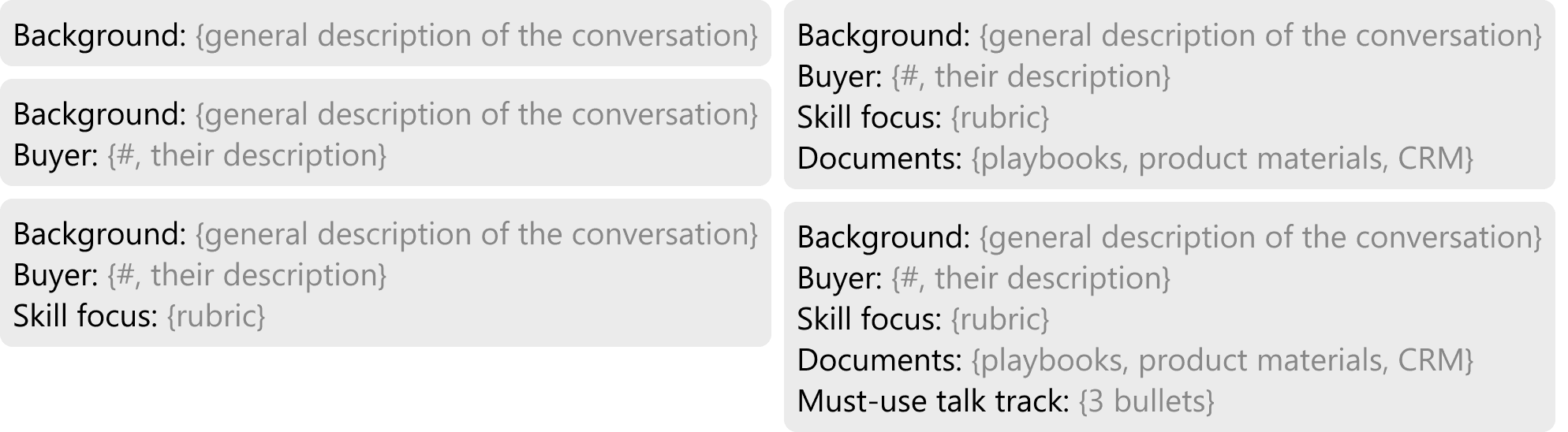
Output evaluated
Copied output from 5 variations and paste it in the system to generate Role Play scenario.
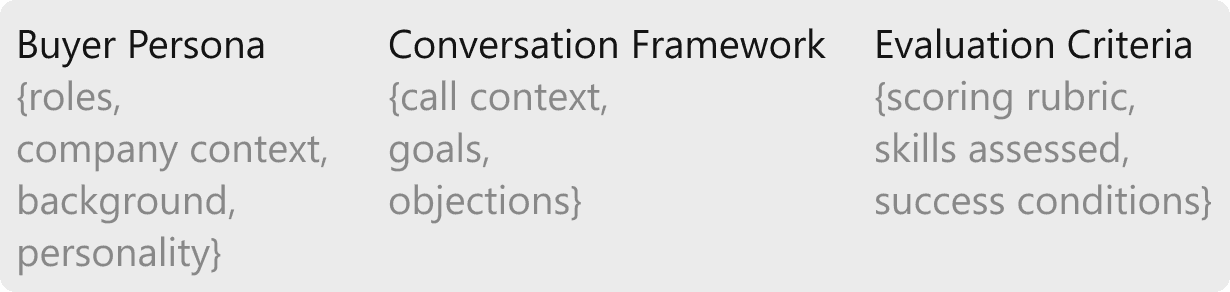
Findings
Minimal inputs produced generic, low-value conversations
Overly detailed prompts made buyers rigid and predictable
Specific, structured paragraphs improves output quality
Rubrics are essential for detailed, actionable, and scorable feedback
The best performing input variation is:
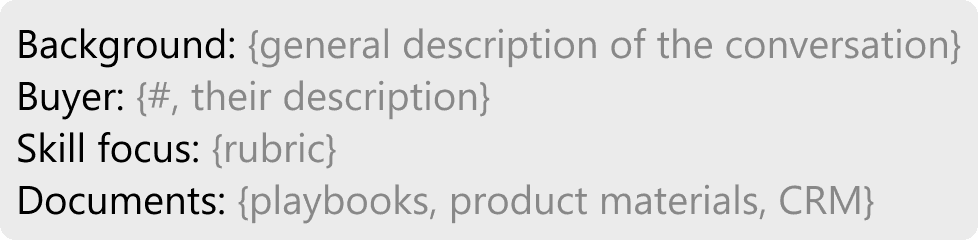
Unstructured information >
Structured input >
Scalable Generation Pattern
3
Designing the North Star creation experience
Exploring what the ideal future experience could look like with vibe coding.
4
Translating information architecture into intuitive interfaces using the design system
Grounded the design in how data flows and how users naturally interact with our design system.
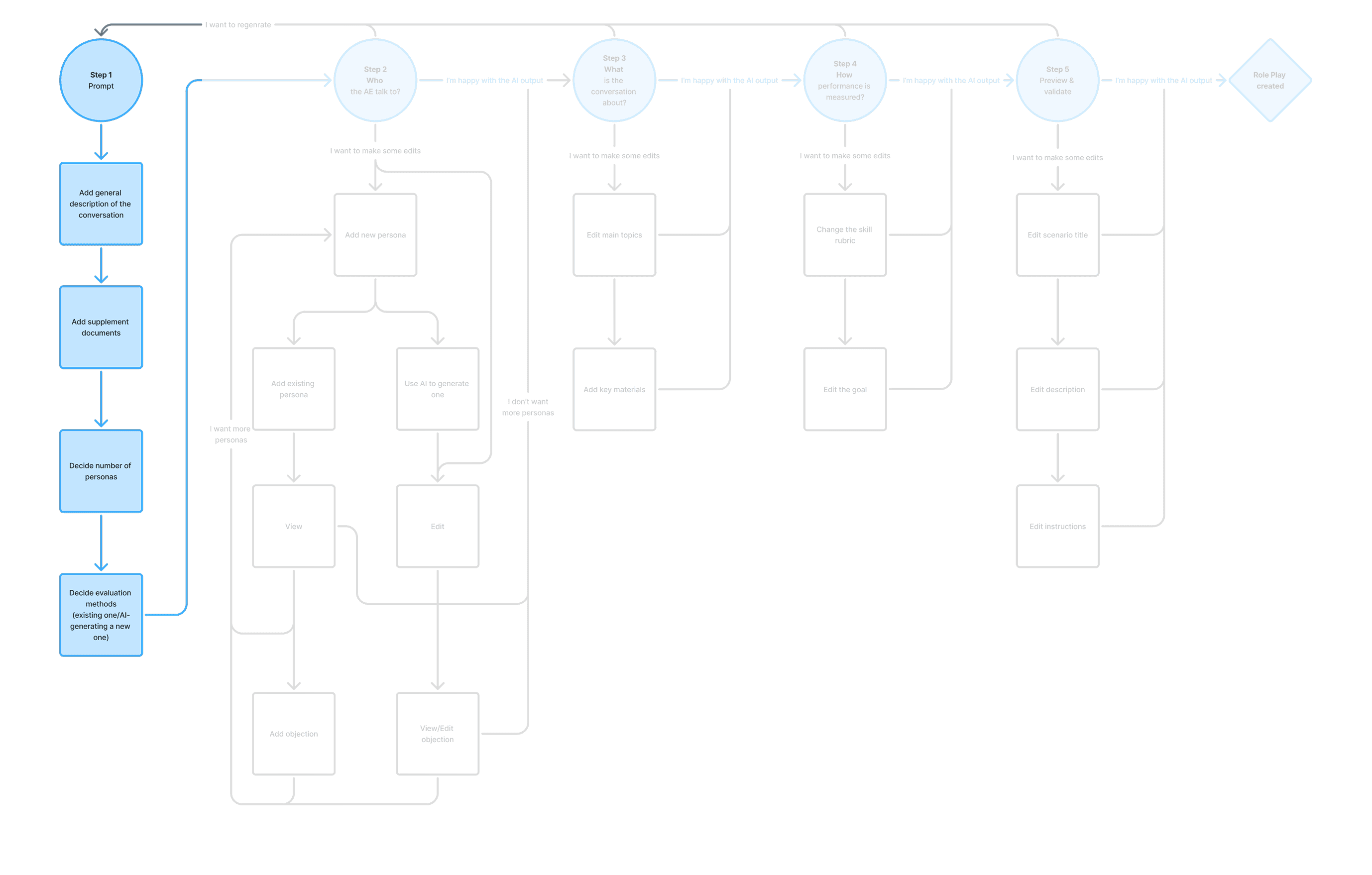
Step 1
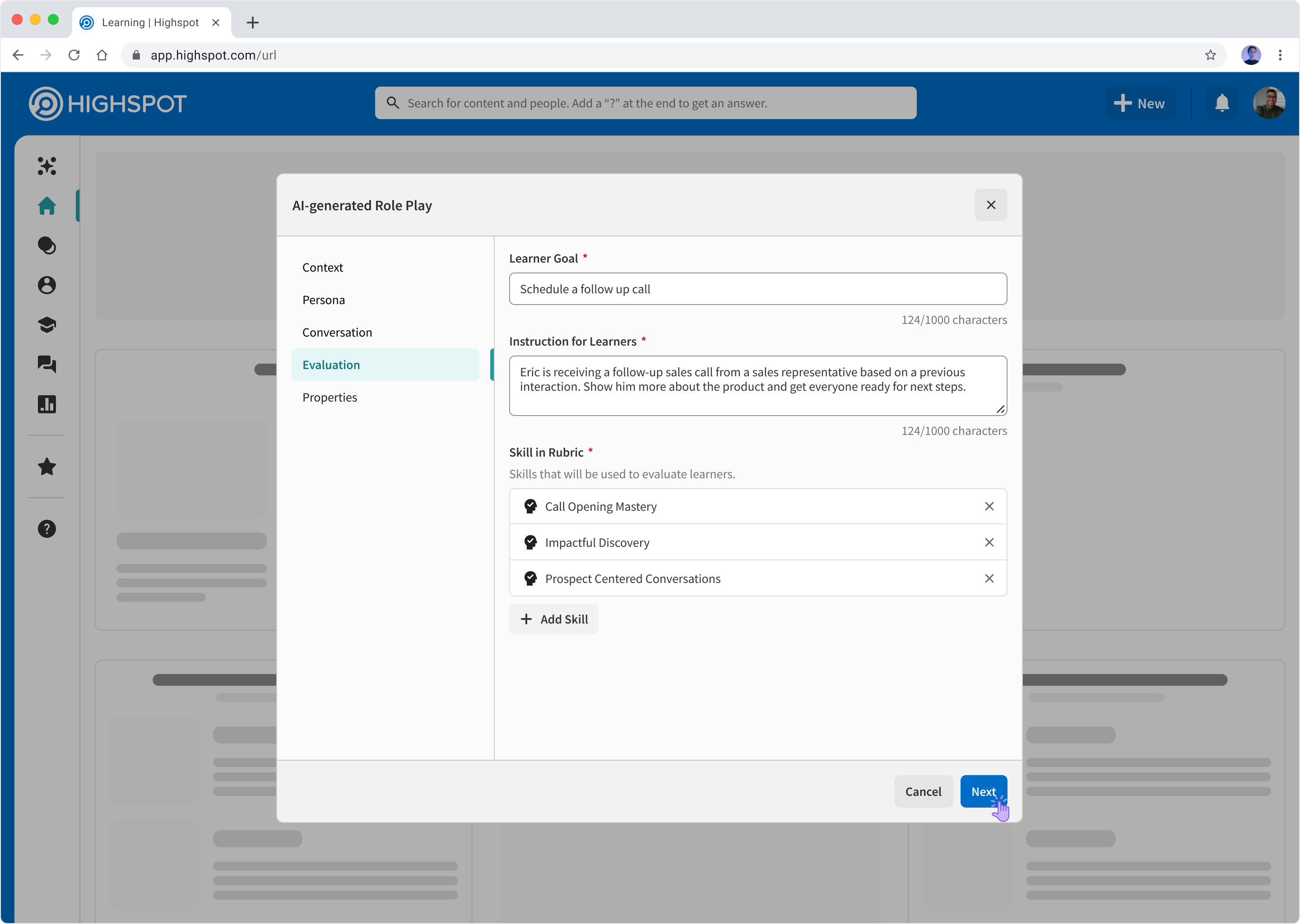
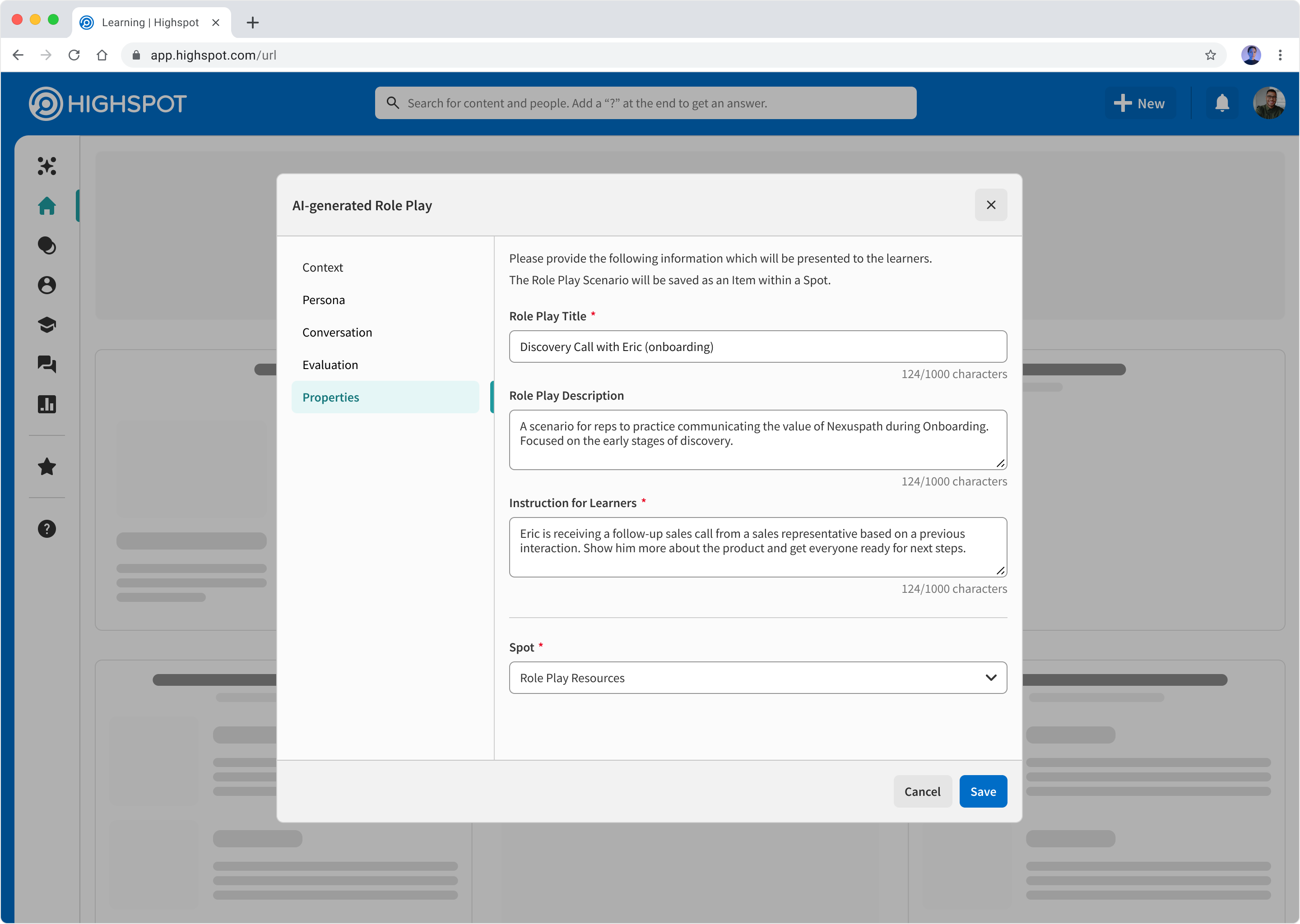
Entering prompt
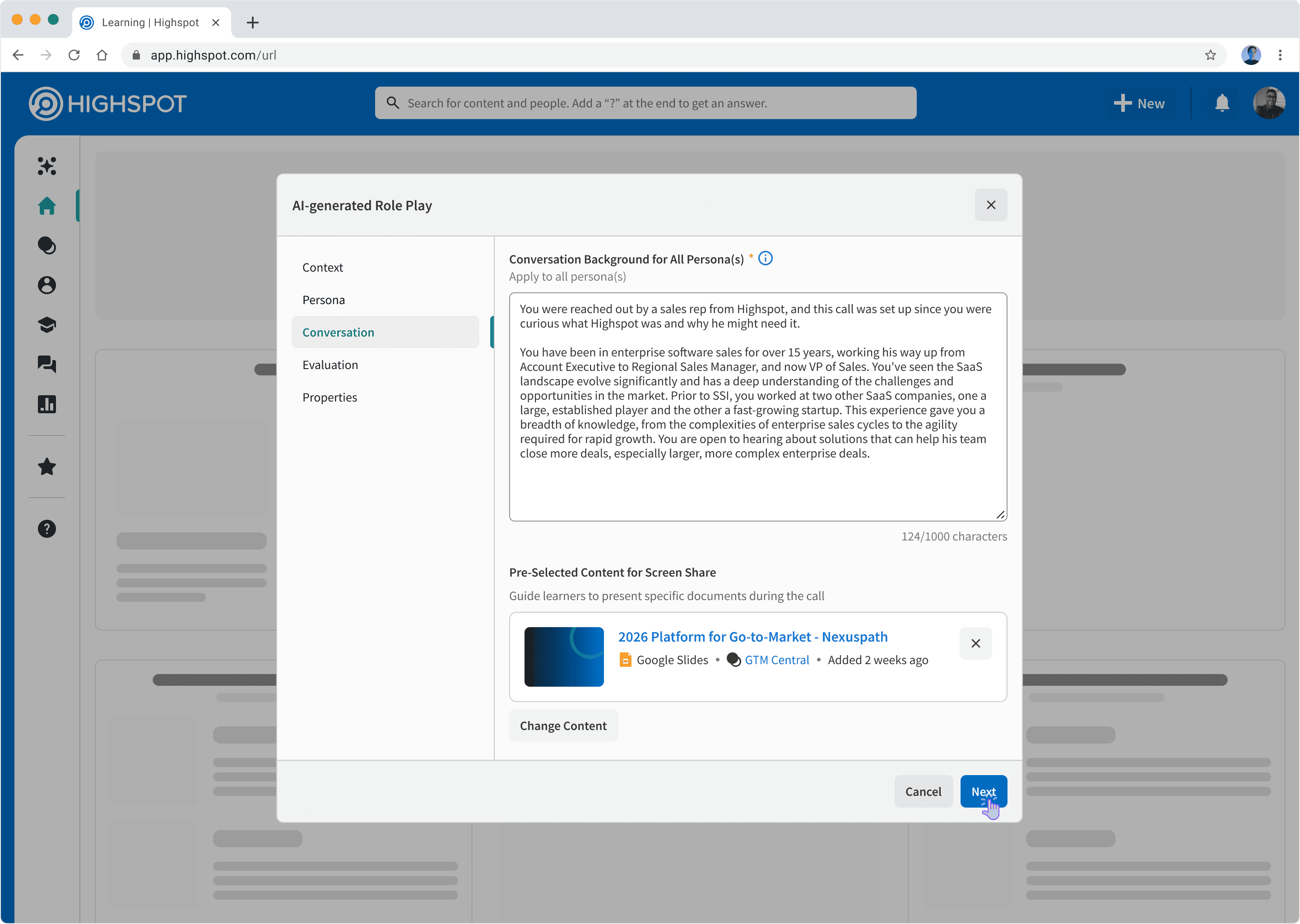
5
Vibe-coding the demo to align the team on what’s next
As shown, admins can generate a role play, but have no way to preview or validate it before publishing.
Because of that, I introduced the concept of an Edit and Preview state, starting in Figma.
a
Edit
allows users to finalize details of the Role play.
b
Preview
allows users to chat with personas to test the quality and see if it works as expected.
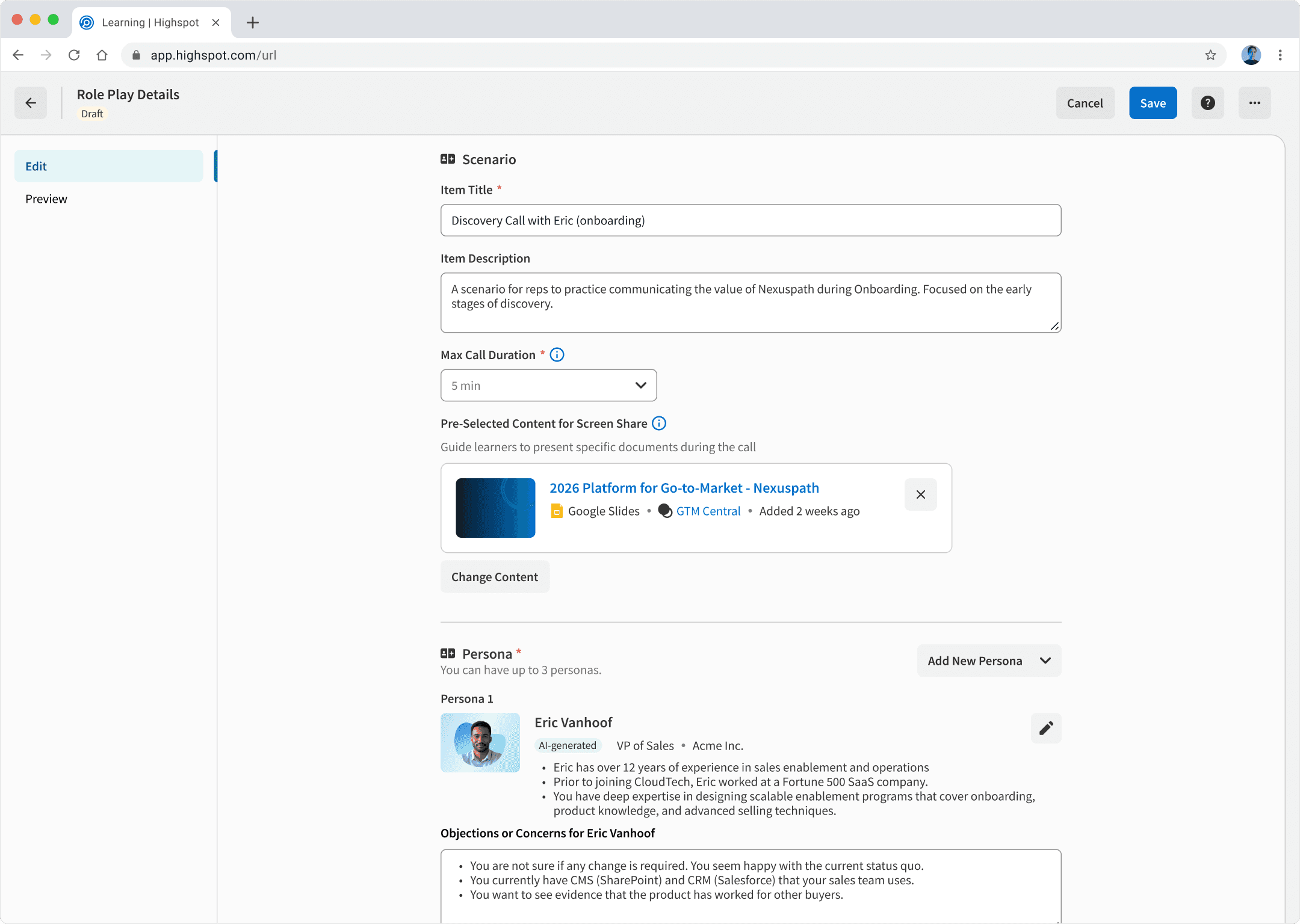
To clearly demonstrate the concept, I vibe-coded a prototype to show it in motion:
After seeing the prototype, the team felt much more confident in the idea, and my PM went ahead to gauge the cost of this.
6
Impact of the my design
We pulled the data from Amplitude to company the activities of the AI-generated flow shown above,

This shows strong adoption and validates both the design direction and our team’s hypothesis — that structured AI generation makes role play creation faster, easier, and more scalable.
We also decided to merge the AI-generated flow with the manual creation flow. This allowed us to reuse the same structure, which reduced engineering cost while keeping the experience consistent.
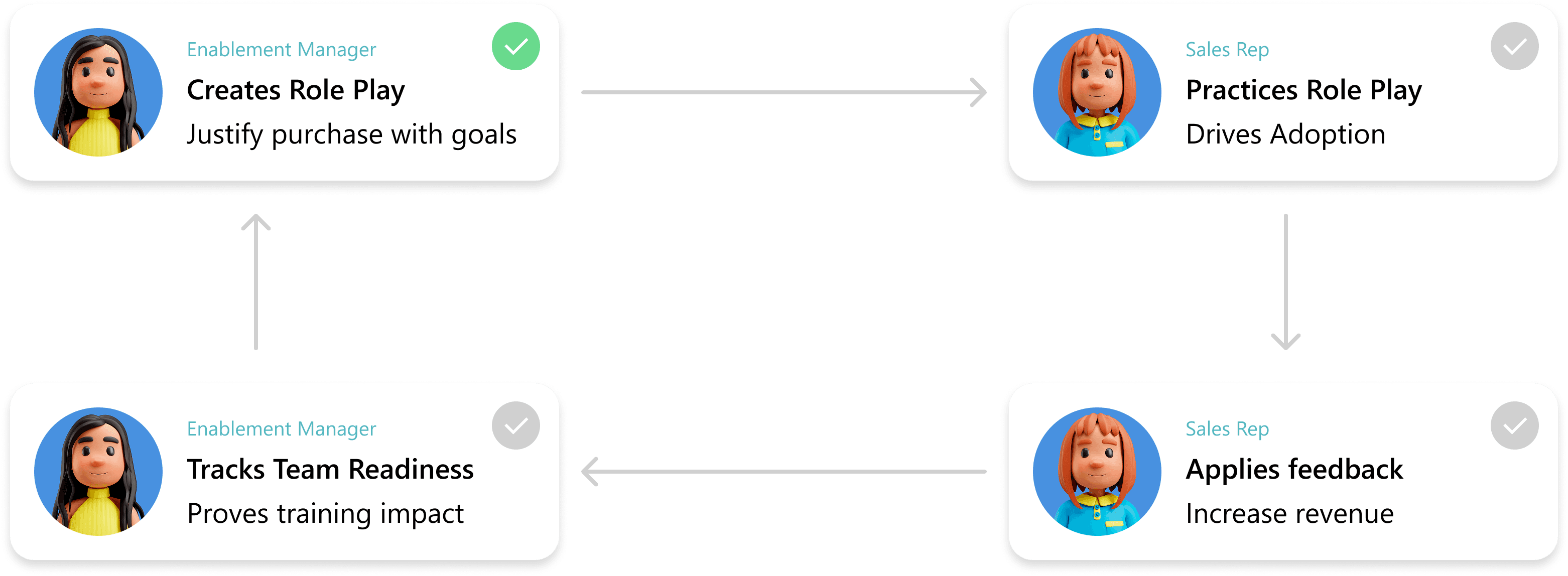
By streamlining the creation experience, we enabled the first step in the enablement loop, helping drive the overall business goal.
How to make Role Play experience engaging?
Even though role play starts as an assignment, my goal was to make it feel valuable, safe, and rewarding, so reps would choose to do it more than once. I started by researching what they want from the experience.
1
User research
Participants
20 sales reps (SDR, AE, AM) — US-based
Method
Structured Survey
Topics
Before: How reps prepare for new messaging and calls
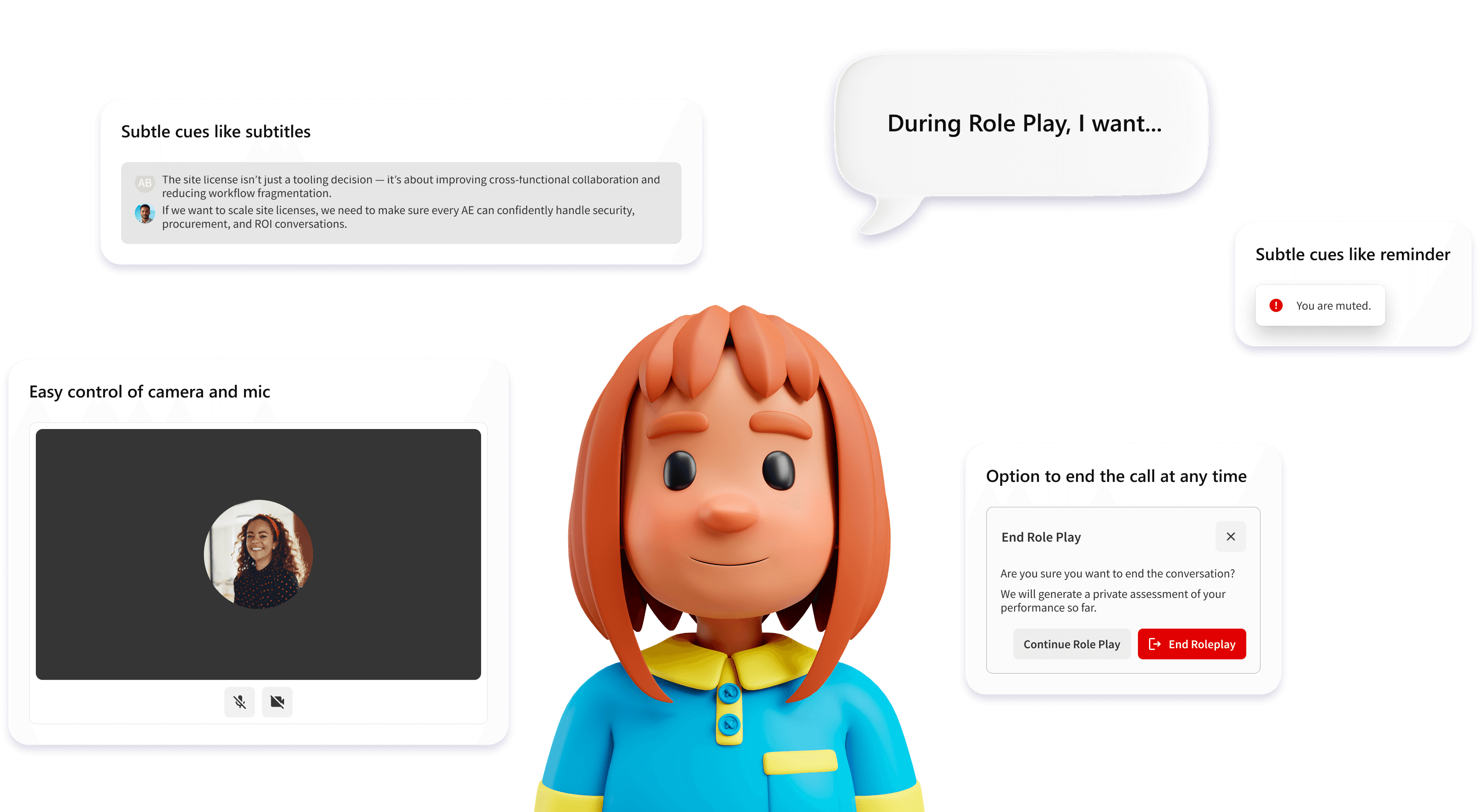
During: What makes practice feel realistic and usable
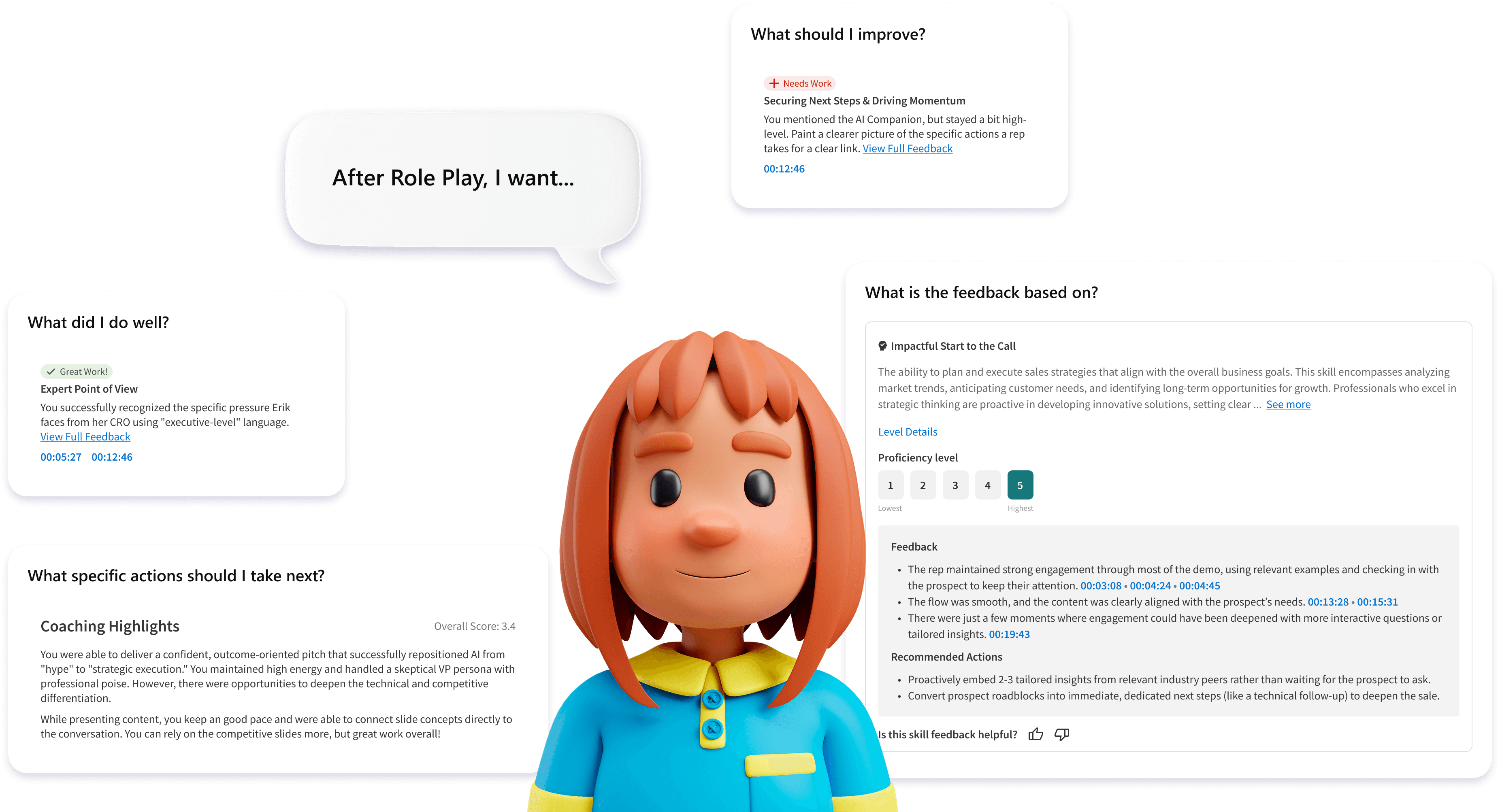
After: What feedback helps them improve and feel ready
Findings
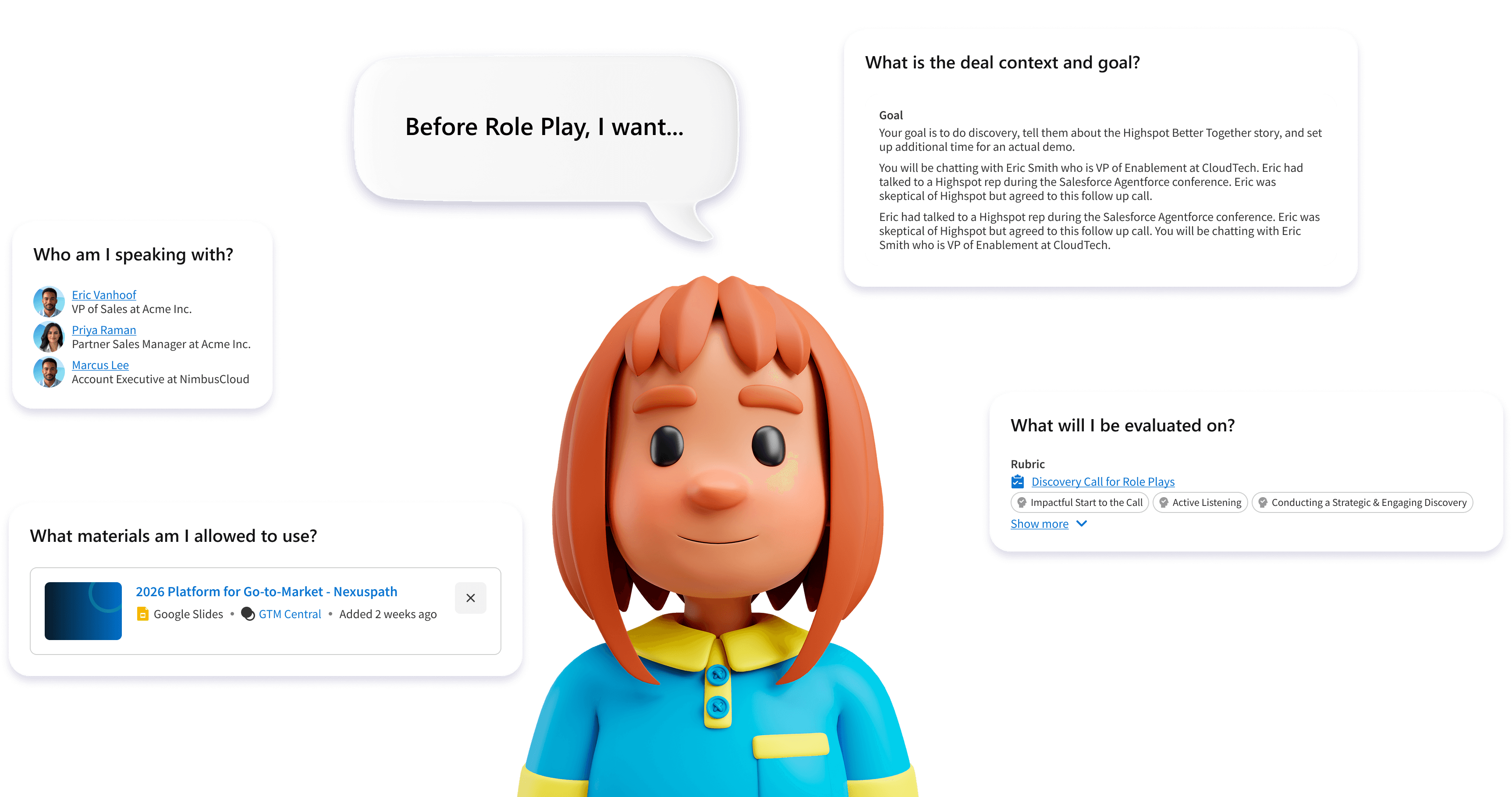
Knowing the goal helps reps set expectations and start with confidence, so clear context must be provided upfront.
Heavy setup discourages practice, so role plays must be pre-assigned with one-click entry.
Because the product is sold across multiple regions, multi-language support is needed
Scores alone are not helpful, so feedback must show observable behaviors and clear next steps.
Hidden criteria reduce trust, so rubrics must be visible and tied to evaluation.
Confidence builds through repetition, so the flow must enable retry without friction.
Translating the research findings into what Alissa wants:
2
Before Role Play
Now we know what information Alissa needs. The question is — how do we present it?
The challenge is to design a role play item page that stays consistent from one to multiple personas, with a clear hierarchy and alignment to the design system. I explored a few directions:

And this is what I eventually landed on:
Scalable
Works seamlessly across single and multiple personas
3 persona
2 persona
1 persona
Consistent
Handles edge cases gracefully, even when information is missing
3
During Role Play
Pre-Call Setup
Help reps feel prepared before the call with the key information they need, plus a simple setup layer to adjust language and preview themselves before getting started.
In-Call Experience
Context On Demand
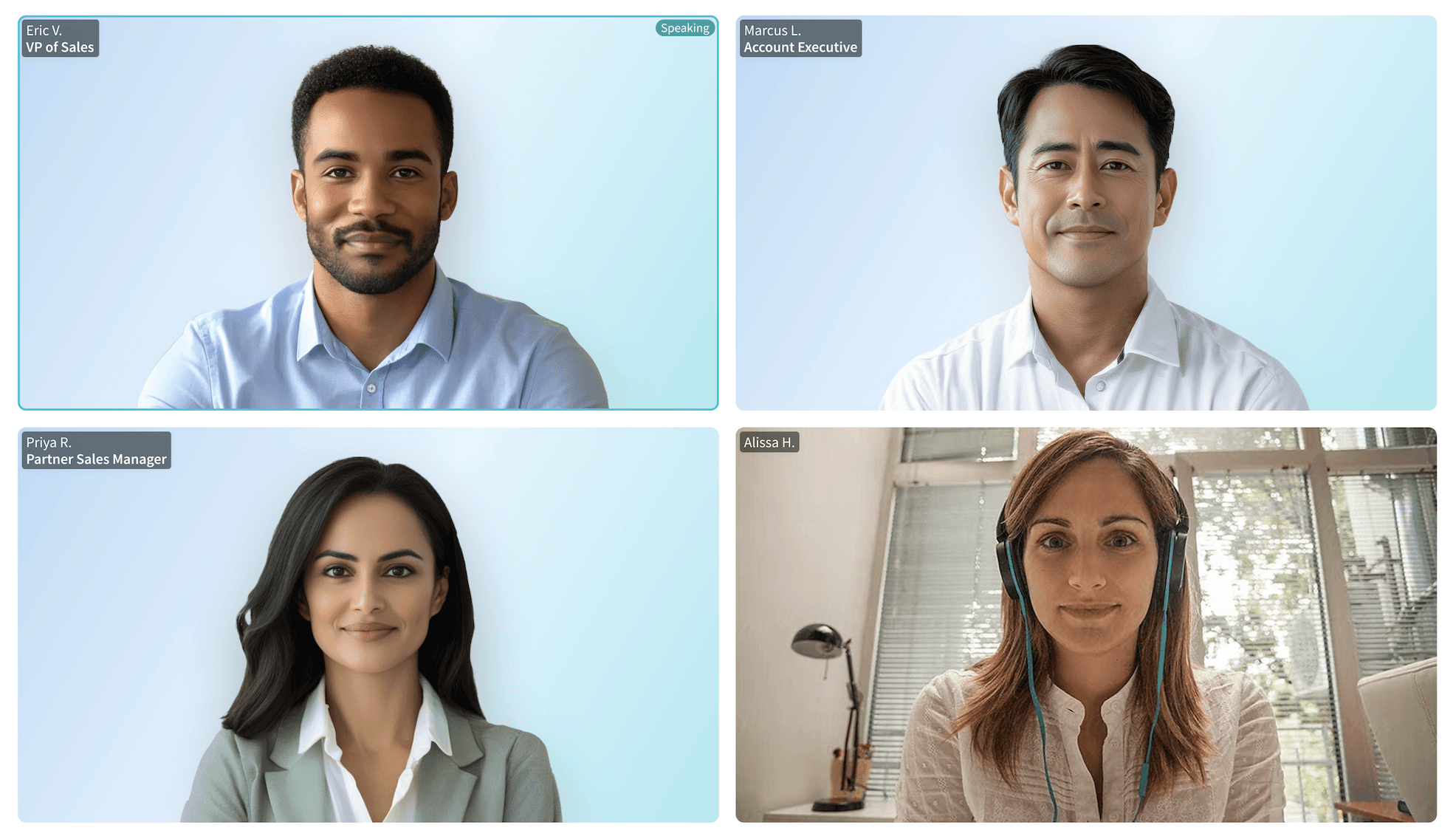
Fully animating them is costly, so I explored lighter design solutions to reduce tension and make the experience feel more comfortable.
I prototyped simple avatar states, thinking, listening, and speaking, using Claude and Adobe After Effects, to match users’ mental model of AI.
We kept the existing layout and adopted the new behaviors, making the experience feel more interactive and less intimidating without adding technical complexity.

By making practice more natural and realistic, we helped drive the next step in the enablement loop.
4
After Role Play
In Highspot, we already have a consistent assessment framework that reps and managers are familiar with. It follows a clear structure: context (what’s being assessed), highlights (overall performance and score), and reasoning (a breakdown of why that score was given).
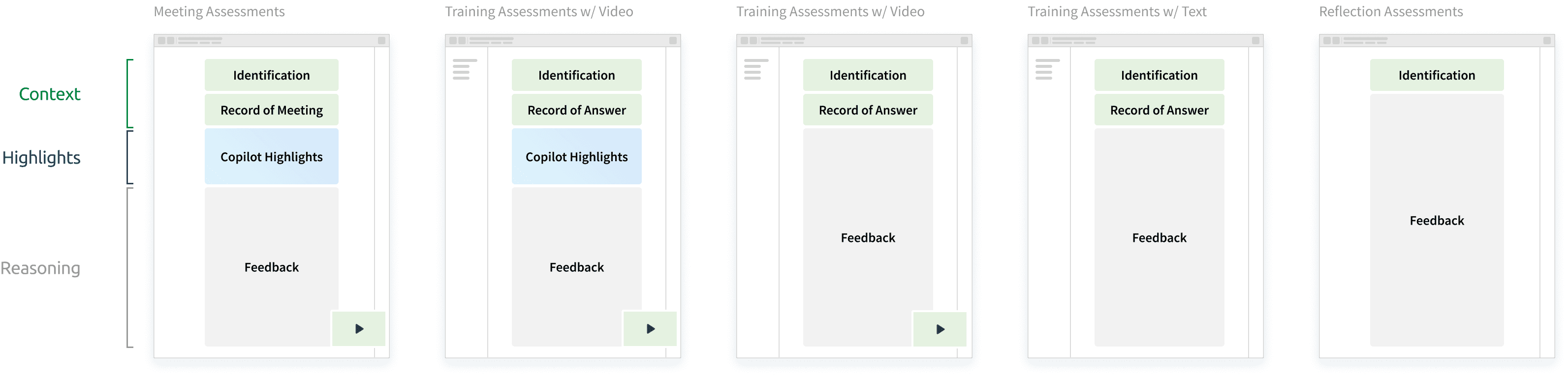
This is how the framework appears in role play. Hover to explore the different ways this UI falls short:
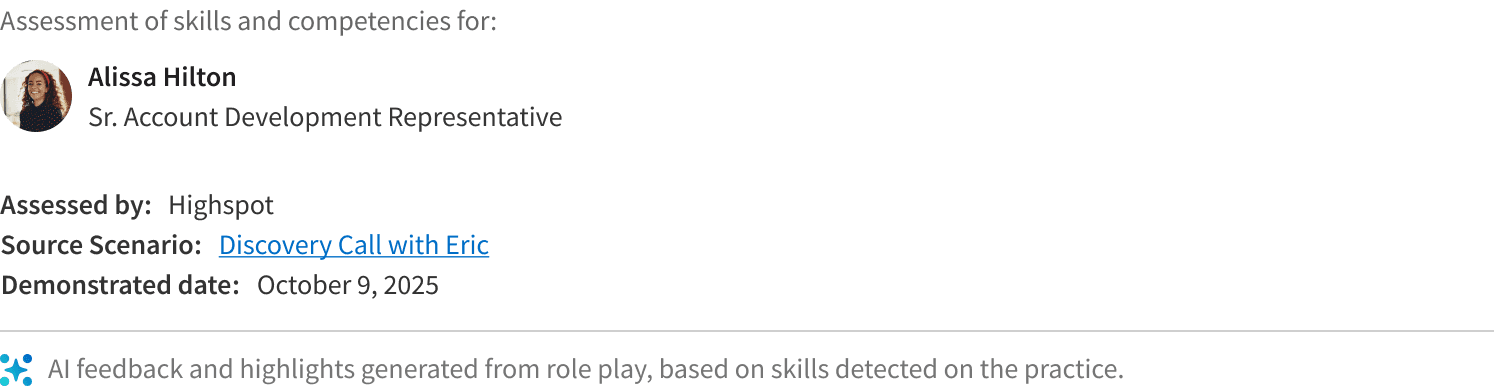
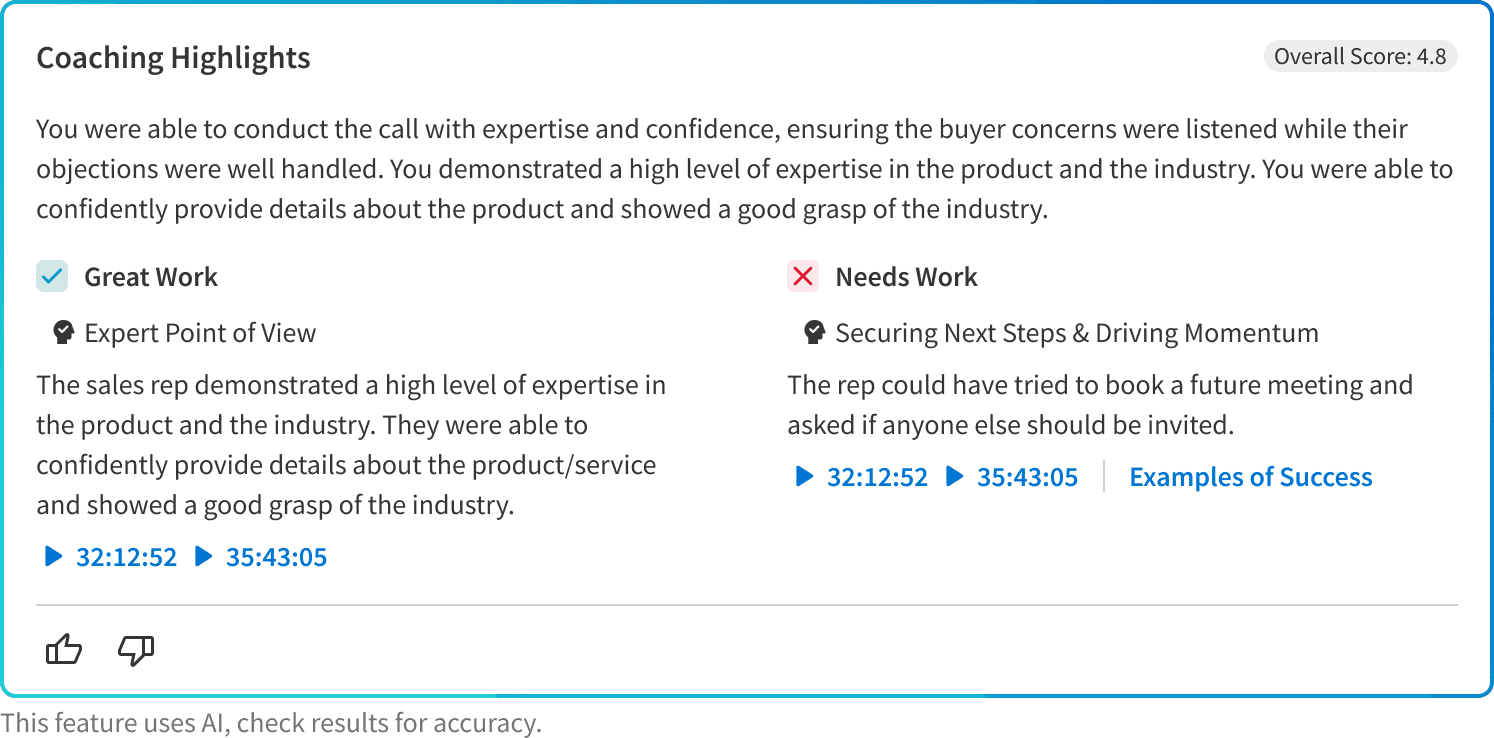
So following the framework, I redesigned 'highlight' and 'reasoning' sections to better fulfill user needs.
What I updated
Separated skills from presentation
Grouped strengths and areas to improve
Tied feedback to specific timestamps
Highlight (Before)
Reasoning (Before)
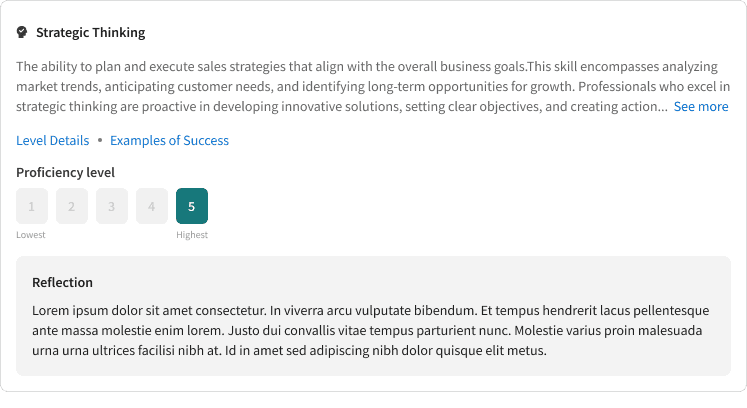
What I updated
Tied feedback to specific timestamps
Replaced long reflection text with concise bullet points
Introduced recommended actions to guide next steps
Let's see what the whole experience look like:

By enabling the full loop, we established a scalable workflow that drives the business goal constantly. The design not only supports business outcomes but also creates a more valuable experience for users.
What did I learn through out the process?
1
Great design simplifies complexity, not exposes it
Design is not a direct translation of backend logic or AI processes. Even as AI products become more transparent, simply showing users what the system is doing does not automatically create a good experience. The role of design is to make complex technology understandable and educational, helping users feel confident and in control.
2
Technical constraints can lead to better design solutions
In product design, not every interaction or idea is technically feasible within the available time or engineering resources. Instead of giving up on the experience entirely, it is important to understand the core user value behind the idea and explore alternative ways to achieve a similar outcome.
3
Designing for multiple stakeholders requires systems thinking
Different users, roles, and license types all have different goals and workflows. But there are shared touchpoints where these experiences connect. Designing for multiple stakeholders means thinking holistically so the product feels consistent and cohesive across different flows and experiences.
4
Defining the right metrics is part of the design process
Good design should connect to measurable user behaviors and business outcomes. Sometimes one metric is enough to validate a decision, but often it requires tracking multiple signals together to understand whether the experience is truly improving engagement, efficiency, or adoption.